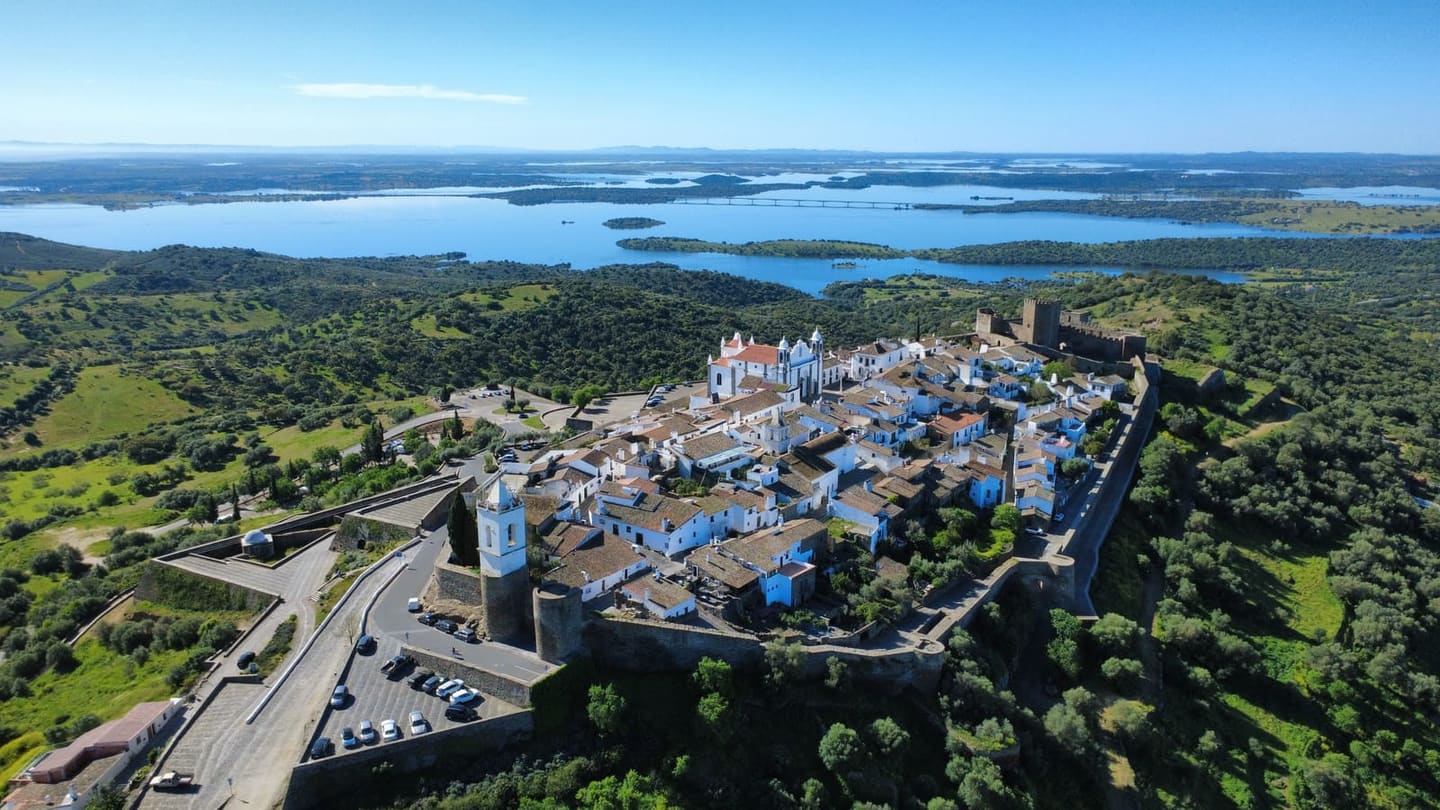
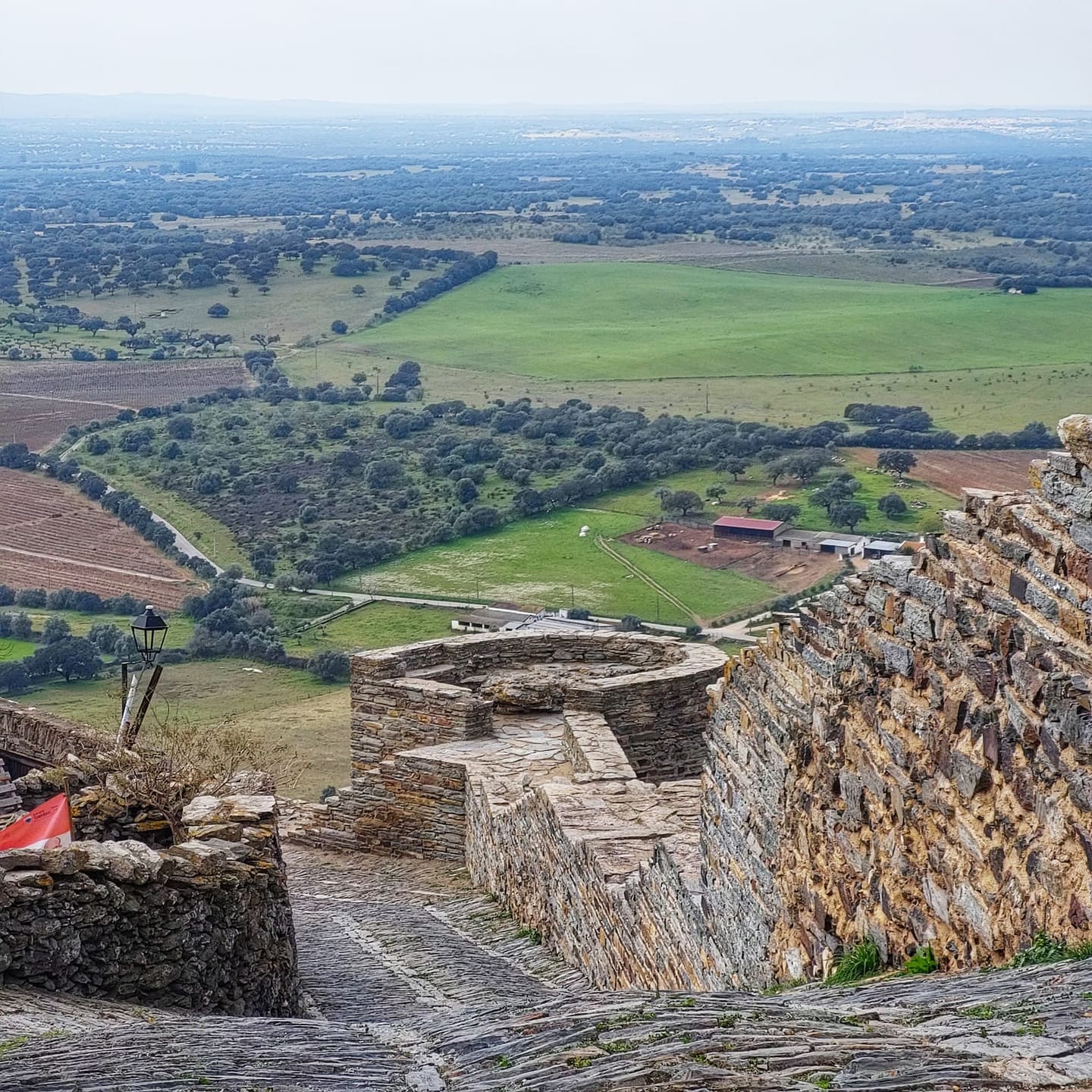
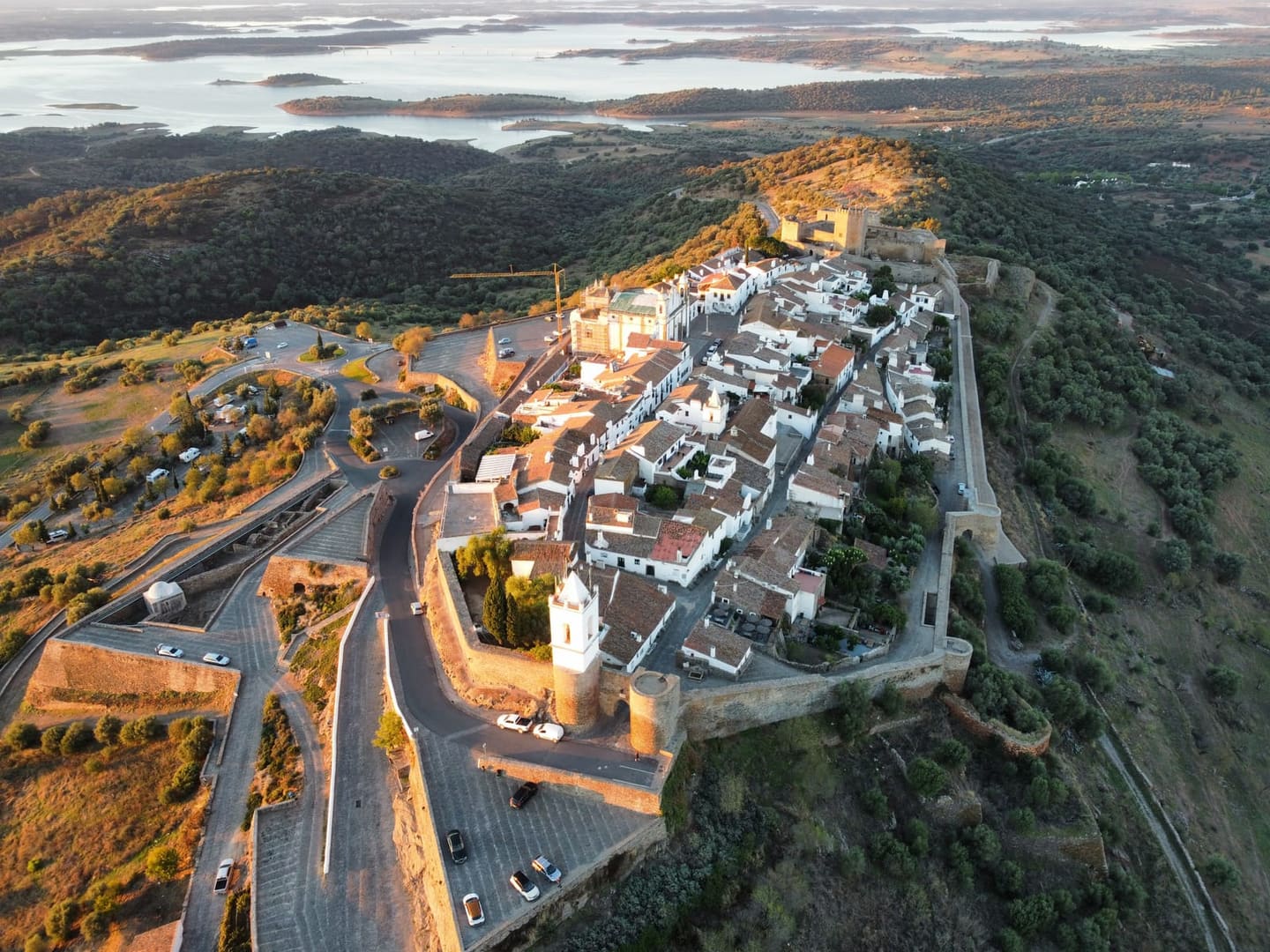
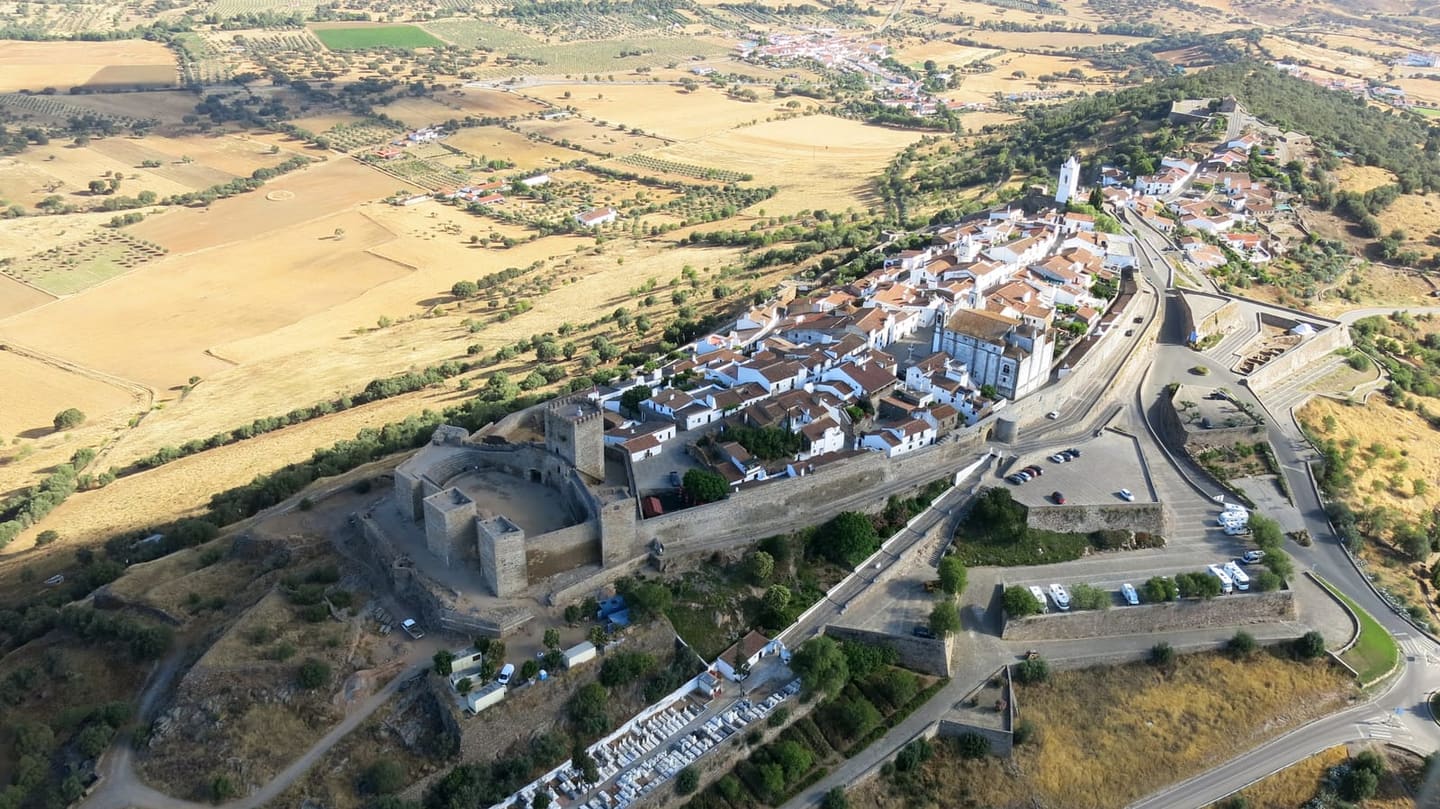
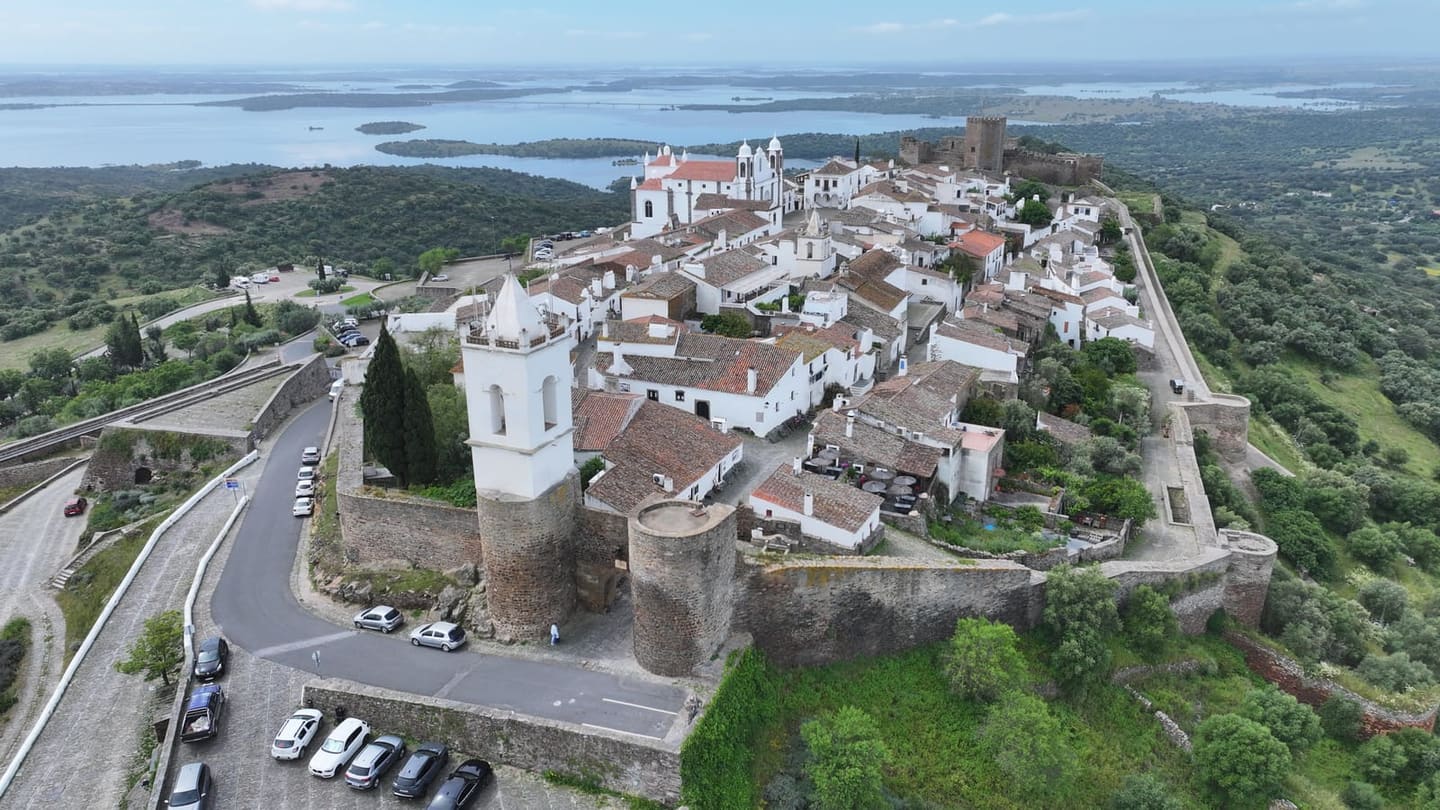
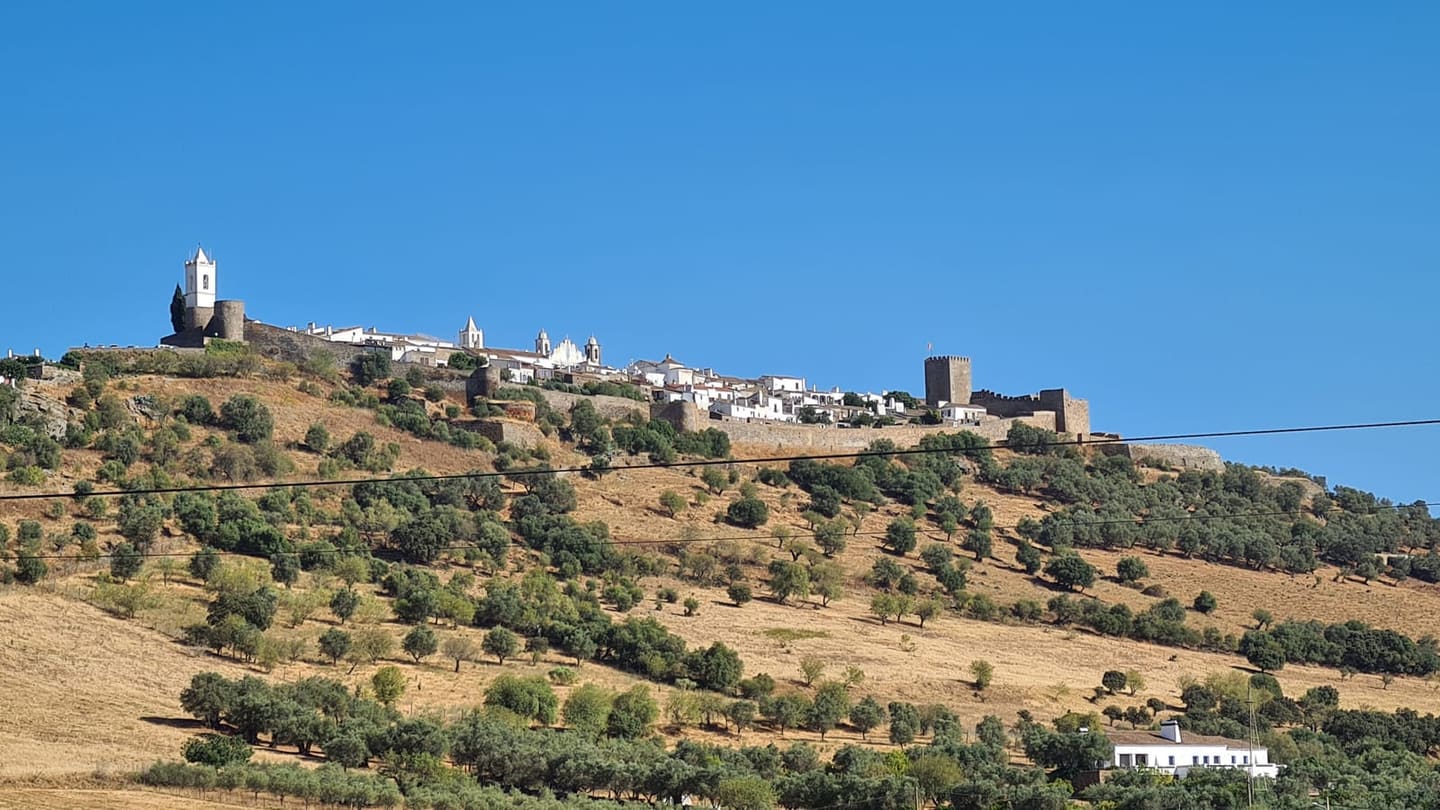
Monsaraz Castle (Castelo de Monsaraz) crowns one of the most beautiful hilltop villages of the Portuguese Alentejo. From its walls you look out over the vast, rolling plains and the blue waters of the Alqueva reservoir, one of the largest artificial lakes in Western Europe.
The village inside the walls has changed little over the centuries: whitewashed houses, narrow cobbled lanes, medieval gates and a silent plaza make it feel as if time has stopped. Because the surroundings are protected against light pollution, the same hilltop is also part of the Dark Sky Alqueva reserve, one of the best places in Portugal to watch the stars.
This guide gives you everything you need to plan a visit: how to get there, what to see, practical facilities, current weather and the history behind the stones.
Visiting Tips
Arrive early in the morning or late in the afternoon to enjoy the streets almost alone and to see the best light.
Bring comfortable walking shoes: the lanes are all cobblestones and steep in places.
Summer days are very hot and shade is scarce — carry water, sunscreen and a hat.
For stargazing, plan a night visit on a moonless, clear evening (check the weather section below).
Attraction Highlights
Hilltop medieval castle and walled village (vila amuralhada)
National Monument (Monumento Nacional) since 1946
Views over Lake Alqueva, one of Western Europe's largest artificial lakes
Inside the Dark Sky Alqueva reserve, a certified Starlight destination
Gateway to wine estates, megalithic sites and the pottery village of São Pedro do Corval
About This Guide
Monsaraz Castle is one of the most precious historical sites of the Portuguese Alentejo. This independent, non-profit guide was written to share its history and to help you visit it well prepared. We do not sell anything and we do not recommend specific businesses — only the official and public sources listed at the bottom of the page.
Medieval castle and walled hilltop village · National Monument
Country
Portugal
Region
Alentejo · Évora District · Municipality of Reguengos de Monsaraz
Town
Monsaraz
Coordinates
38.4423° N, 7.3817° W
Plus Code
CJR9+W8 · Mourão, Portugal
Google Rating
4.7/5 (15,081)
Address
Largo do Castelo, Monsaraz, 7200-175 Reguengos de Monsaraz, Portugal
Opening Hours
Castle, Walls & Village
The esplanade, walls, gates and streets of the walled village are free to visit and normally open 24 hours a day (they form the living heart of the town).
Interiors & the Keep
The keep (Torre de Menagem) and any exhibition spaces inside the monument follow short, seasonal schedules that change from year to year. Check locally before planning your day around them.
Best Time to Visit
April–June and September–October offer the most pleasant weather. July and August are very hot but perfect for late sunsets; winter is quiet and clear for stargazing.
Practical Note
Night lighting inside the village is limited. If you stay for sunset or stargazing, bring a torch, watch your step on the cobblestones and note that the walk back to the car parks is uphill-free but dark in places.
Opening arrangements may change on public holidays and during local festivals — always confirm with the municipal tourism office before your visit.
Admission & Tickets
Entry to the Monument
Access to the castle esplanade, the walls and the streets of the walled village is free of charge and requires no ticket. As a living village, there is no single gate or ticket office.
Keep & Temporary Exhibitions
Guided visits and any temporary exhibitions or monuments open with limited schedules (the keep, churches and small museums). Prices vary by event and are set by the organising entities.
Parking
Several free car parks line the roads just outside the walls. Driving inside the village is restricted for residents only. In peak season, spaces fill up by mid-morning.
Honest Advice
The outdoor monument has no online ticket system — simply arrive. If you particularly want to see the interior of the keep or a church, ask at the local tourism office about the day's schedule.
How to Get There
From the Airports
Lisbon Airport (LIS) is about 180 km away (roughly a 2-hour drive); Faro Airport (FAO) is about 210 km away (roughly 2.5 hours). Renting a car at the airport is by far the most practical option for this region.
By Car
From Lisbon take the A2 south, then the A6 towards Évora and continue on the IP2/N18 towards Reguengos de Monsaraz, finishing on local roads that climb to the village. From Spain (Badajoz), the A6 and N256 bring you to the same area. Follow the signs for Monsaraz; several free car parks are located just outside the walls.
Public Transport
Rede Expressos buses connect Lisbon (Sete Rios) with Évora and Reguengos de Monsaraz. From Reguengos, a local Rodoviária do Alentejo service or taxi covers the last 15 km to Monsaraz. Schedules are sparse — always check the current timetable before travelling.
Getting Around
Inside the walls everything is on foot. From the car parks you enter through the historic gates and follow the cobbled lanes uphill to the castle. The climb is short but steep in places.
Cycling
The gently rolling Alentejo roads around Monsaraz and the Alqueva reservoir are a favourite for road and gravel cyclists. Note that the final climb to the village is steep.
Travel Tips
Because public transport is limited, a hire car gives you the freedom to combine Monsaraz with the Alqueva lake shore, nearby wine estates, the megalithic sites (menhirs and cromlechs) and the pottery village of São Pedro do Corval.
Weather in Monsaraz
Current conditions and a multi-day forecast for the castle hilltop (38.44° N, 7.38° W), refreshed every 30 minutes.
CurrentUpdated 06:36
9°
Partly cloudy
Feels like: 8°Wind: 1 km/hHumidity: 91%
Forecast
Wed
21 Oct
23°/9°
Thu
22 Oct
22°/5°
Fri
23 Oct
23°/8°
Sat
24 Oct
24°/6°
Sun
25 Oct
24°/8°
Mon
26 Oct
27°/10°
Facilities & Everyday Services
Monsaraz is a small living village, not a purpose-built attraction. The facilities below are listed by type only — as an independent, non-commercial guide we do not recommend specific businesses. Availability changes with the season, so always confirm locally.
01
Public Toilets (WC)
Public toilets inside the walls are scarce. Public facilities exist around the car-park areas and the tourism-related services in the village. Cafés and restaurants generally serve their own customers.
02
Parking
Free public car parks line the approach roads just below the walls. Driving is restricted inside the village. In July and August and on holiday weekends, arrive before 10:00 or accept a longer walk.
03
Restaurants & Cafés
Inside the walls you will find a handful of traditional restaurants, snack bars and cafés serving Alentejo food and local wines. Quantity is limited, so reserve a table in advance during the high season.
04
Accommodation
The village offers a small number of guesthouses, country houses and holiday homes. Most visitors stay in the wider municipality of Reguengos de Monsaraz or by the Alqueva lakeshore. See the Accommodation section further down this page for general guidance.
05
Grocery Shops
There is no large supermarket inside the walls — only very small convenience shops with limited stock. For full grocery shopping, use the supermarkets of Reguengos de Monsaraz (about 15 km away) before you arrive.
06
Fuel & EV Charging
No petrol station operates inside the village. The nearest fuel stations are in Reguengos de Monsaraz and on the approach roads around the Alqueva area. EV charging points are also found in the larger centres nearby.
07
ATMs & Cash
There is no permanent ATM inside the walls. Carry cash for small shops and cafés, or withdraw money in Reguengos de Monsaraz. Cards are accepted at most restaurants and larger shops.
08
Pharmacy & Health
The nearest pharmacy is in Reguengos de Monsaraz. For anything urgent, head to the health centre there or, for serious cases, to the hospital of Évora or Beja. Carry any medication you may need.
09
Drinking Water & Shade
Public drinking fountains are rare on the hilltop. In summer, bring your own water — at least one litre per person — and plan indoor stops during the hottest hours.
History of Monsaraz Castle
Behind the picture-postcard walls lies more than eight centuries of Portuguese frontier history — from the Reconquista and the Knights Templar to a fortress rebuilt by kings, battered by wars and finally reborn as a place of silence, wine and stars.
01
An Ancient Frontier Hill
People have watched over this landscape for thousands of years. The Alentejo plains around Monsaraz preserve some of Europe's densest megalithic remains — menhirs and cromlechs raised long before any castle existed — and Roman roads once crossed the region.
By the Islamic period a small fortified settlement guarded this frontier area. The hill's commanding position over the Guadiana valley explains why every power that ruled the region wanted to control it.
02
The Reconquista and Geraldo Sem Pavor
In 1167 the legendary frontier warlord Geraldo Sem Pavor — “Geraldo the Fearless” — took Monsaraz from Muslim rule in the name of the first Portuguese king, Afonso Henriques.
The conquest was not final. Almohad forces recaptured the region in 1175, and only after the decisive Christian campaigns of 1232 did Monsaraz pass permanently into the Kingdom of Portugal. The castle then became a key link in a chain of border fortresses protecting the young kingdom.
03
A Castle of the Knights Templar
In 1232 King Sancho II donated Monsaraz to the Order of the Knights Templar, whose frontier experience made them ideal guardians of this marchland. A charter (foral) granted by King Afonso III in 1276 confirmed the town's importance.
When the Templars were dissolved in the early 14th century, their Portuguese possessions passed to the Order of Christ. Inside the nearby parish church of Santa Maria da Lagoa you can still see the carved medieval tomb of Gomes Martins Silvestre, a nobleman connected to the Order.
04
Walls, Gates and the Keep
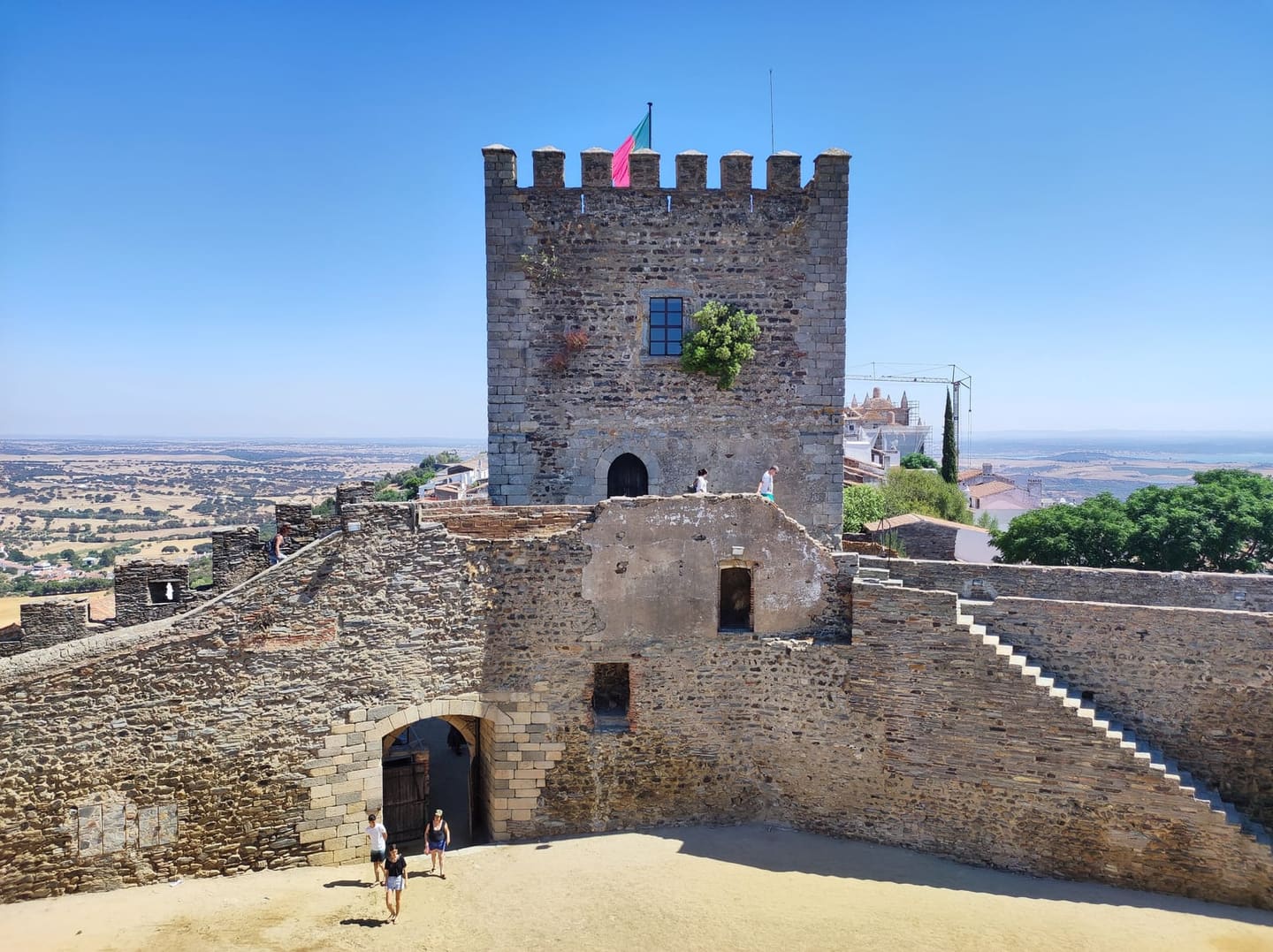
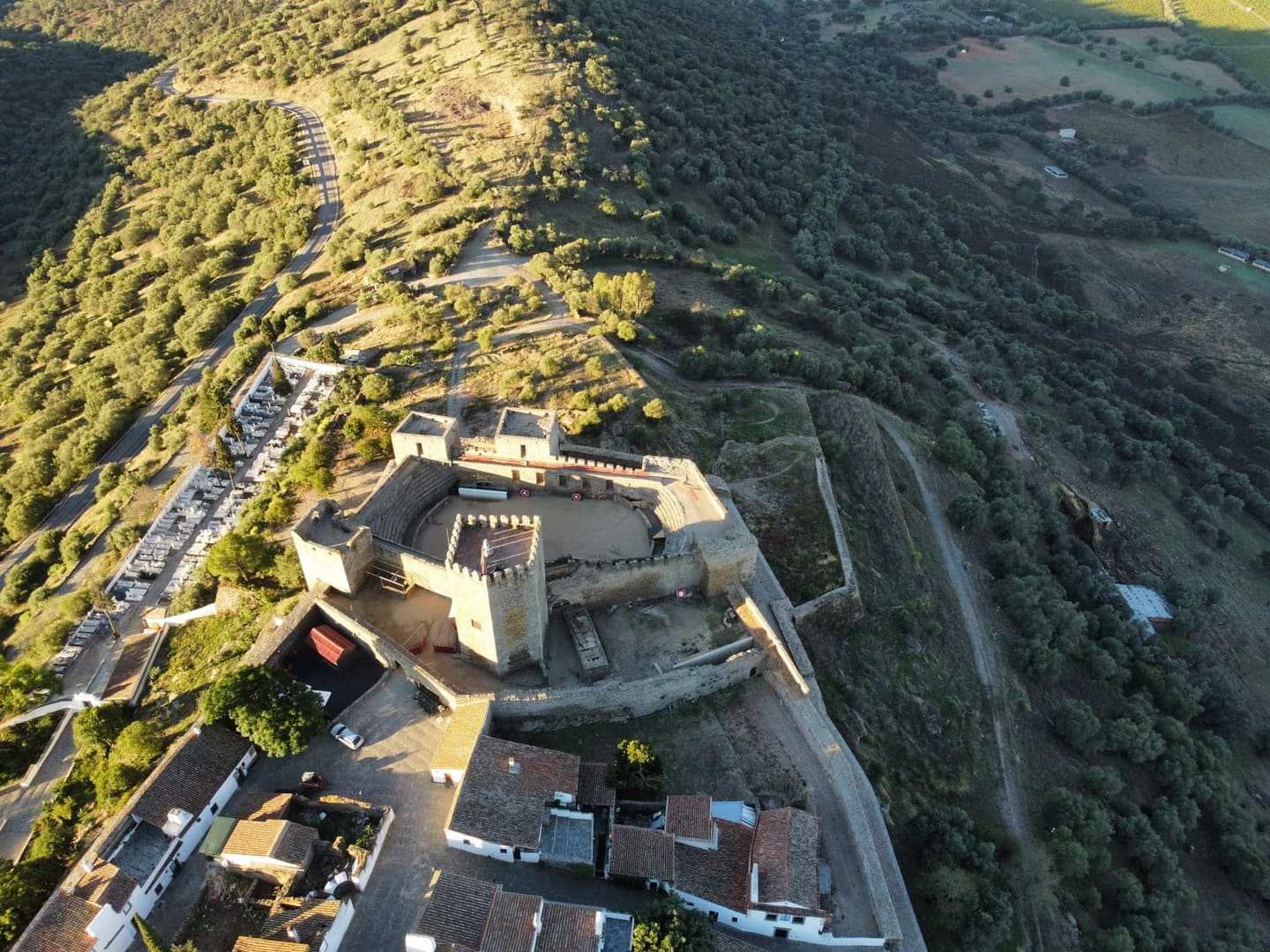
Around 1310 King Dinis ordered the castle rebuilt and strengthened — work that largely shaped the fortress you see today. The walls, built mainly of local schist with granite ashlar around the gates, form an oval perimeter around the village.
The walls were pierced by four gates: Porta da Vila, the main entrance crowned by a clock tower added in 1692, Porta de Évora, Porta da Alcoba and Porta da Cisterna. Inside, the rectangular castle and its keep (Torre de Menagem) crown the highest point of the hill. The early 16th-century Book of Fortresses by Duarte de Armas preserves one of the oldest drawings of Monsaraz.
05
From Border Fortress to National Monument
During the Portuguese Restoration War (1640–1668) Monsaraz once more faced Spain across the border. French military engineers, including Nicolau de Langres and Jean Gillot, designed bastioned defences around the old walls, and the Forte de São Bento was built outside the village.
When peace returned and the municipality's seat moved down to Reguengos de Monsaraz in the 19th century, the hilltop town lost its military and administrative role — and, paradoxically, was left beautifully untouched. In 1946 the castle and walls were classified as a National Monument (Monumento Nacional). In 1987 the village symbolically offered the keys of the castle to the President of the Republic, Mário Soares, during his visit.
06
Lake Alqueva and the Starry Sky
The greatest change to the landscape came in the 21st century. The construction of the Alqueva dam (1995–2002) created one of the largest artificial lakes in Western Europe, flooding the lower valley and bringing the water's edge within sight of the castle.
The region then discovered a second treasure: its exceptionally clear, dark night sky. The surrounding area was certified in 2011 as Dark Sky Alqueva, the first destination in the world to receive Starlight tourism certification. Today, gazing up from the castle esplanade on a moonless night is one of the most memorable experiences in the Alentejo.
Stories & Legends
Behind the walls: nine true episodes — between history and legend — that shaped Monsaraz.
Documented history
Geraldo Sem Pavor and the capture of 1167
In 1167 the celebrated frontier captain Geraldo Sem Pavor — “the Fearless” — seized Monsaraz from Muslim hands on behalf of King Afonso Henriques. It was one of a dazzling series of raids that pushed the young kingdom's border deep into the Alentejo. The triumph was brief: the Almohads retook the region in 1175, and only after the campaigns of 1232 did the hill finally stay Portuguese.
Documented history
Guardians in white mantles: the Templars
In 1232 King Sancho II gave Monsaraz to the Knights Templar, veterans of border warfare. Wherever they served, they left their mark — and Monsaraz was no exception. Inside the parish church of Santa Maria da Lagoa rests the carved tomb of Gomes Martins Silvestre, a nobleman linked to the Order, while Templar crosses can still be seen carved into stone in the region. When the Order was abolished in 1312, its Portuguese lands passed to the successor Order of Christ.
Documented history
A king's order: D. Dinis rebuilds (c. 1310)
At the beginning of the 14th century King Dinis, the ‘Farmer King’ who built many of Portugal's castles, ordered Monsaraz rebuilt and strengthened. The work gave the fortress its present silhouette: a keep and inner castle at the summit, an oval curtain of schist walls around the town and gates of solid granite. For the next three centuries this was the castle the frontier knew.
History & legend
The crisis of 1383–85: when the castle changed hands
During Portugal's great dynastic crisis of 1383–85, Monsaraz was drawn into the war between Portugal and Castile. Castilian forces seized the castle, and it was only after the Portuguese victory at Aljubarrota that the constable Nuno Álvares Pereira retook it for King João I. Local tradition still recounts those tense months when the hill changed hands and the border could have fallen either way.
Documented history
Bulwarks against Spain: the 17th century
After 1640, Portugal fought a long Restoration War to keep its independence from Spain. Monsaraz became a frontline fortress once more. French engineers in Portuguese service — Nicolau de Langres and Jean Gillot — designed star-shaped bastions around the medieval walls, and the Forte de São Bento was raised just outside the village. Today its low silhouettes are a quiet relic of that warlike century.
Modern story
The keys of the castle and the starry revival
In 1987 the people of Monsaraz symbolically offered the keys of their castle to President Mário Soares — a gesture of friendship from a town whose fortress no longer had any military purpose. Then came Alqueva: the great dam filled the valley after 2002, turning the border fortress into a lakeside viewpoint. In 2011 the region was certified Dark Sky Alqueva, the world's first Starlight tourism destination. The old sentinel of the frontier now watches over water, vineyards — and the stars.
Documented history
The 1276 charter: rights for the hilltop town
In 1276 King Afonso III granted Monsaraz a foral — a charter that set down in writing the town's rights and duties. Holding a charter meant the town could run its own council, elect judges and officials and hold a market: marks of self-rule that drew people and trade to this frontier. In the early modern era the charter was renewed as part of the Manueline reforms — proof that the town still counted.
Documented history
A portrait from c. 1510: the Book of Fortresses
Around 1510, King Manuel I commissioned the draughtsman Duarte de Armas to travel the kingdom and draw its border castles. The result — the celebrated Book of Fortresses — preserves one of the oldest known images of Monsaraz, showing the keep, the walls and the layout of the gates as they stood more than 500 years ago. In 2017 the illuminated manuscript was added to the Portuguese register of UNESCO's Memory of the World programme.
Beyond the walls
The sacred horizon: menhirs and stone circles nearby
Monsaraz does not only crown a hill — it sits at the heart of one of Europe's richest megalithic regions. A few kilometres away stand menhirs and stone circles raised thousands of years before the castle existed. The Outeiro menhir, almost at the gates of the village, is a great starting point; further afield, the stone circles of Xerez form one of the Alentejo's most remarkable assemblies of standing stones. Combining the castle with these sites is one of the most rewarding ways to explore the region.
Suggested Walking Route
Half a day is enough to enjoy the village and the castle calmly; a full day lets you add the Alqueva lakeshore. Below is a natural walking route that starts at the car park and ends back where you began.
1
Park in one of the free lots below the walls and walk up to the main gate, Porta da Vila, with its 1692 clock tower.
2
Pause under the arch where medieval trade measures are carved into the stone, then continue along Rua Direita, the main cobbled street of white houses.
3
Reach the main square with its pillory (pelourinho), the old Misericórdia church and the Town Hall.
4
Visit the parish church of Nossa Senhora da Lagoa — look for the carved medieval tomb of Gomes Martins Silvestre inside.
5
Climb to the castle esplanade and walk the perimeter of the walls for the great panorama over the village, the Alentejo plains and Lake Alqueva.
6
From the walls, look for the Forte de São Bento, the 17th-century bastioned fort that protected the castle from the Spanish border.
7
Wander back through the quieter lanes; stop in the small shops and galleries for local crafts, wine and pottery.
8
Stay for sunset on the western walls — the warm light on the whitewashed village is unforgettable.
9
On a clear night, linger a little longer: the esplanade is one of the easiest dark-sky viewpoints in the reserve.
Good to Know
Cobblestones become slippery after rain and are uneven — wear flat, non-slip shoes.
Dining and shopping options inside the walls are limited to a handful of restaurants, snack bars and small shops; in high season, book a table early in the day.
Summer midday heat is intense and shade is scarce: plan indoor visits (churches, museum spaces) for the hottest hours.
Free public toilets are scarce inside the village; cafés and restaurants generally reserve facilities for customers.
If you are staying overnight for stargazing, bring warm layers even in summer — nights cool down quickly on the hilltop.
Best Photo Spots
1
Castle Esplanade & Keep
The highest viewpoint: the keep and the walls frame the village below and the Alqueva reservoir on the horizon.
2
Porta da Vila Gate
The main gate with its 1692 clock tower is the classic entrance portrait, especially in the morning light.
3
Rua Direita
The whitewashed main street lined with flowerpots and blue trim is pure Alentejo charm.
4
Pillory Square
The pelourinho, the Misericórdia church and the austere white façades compose a perfect medieval square scene.
5
Western Walls at Sunset
Golden hour over the plains and the lake; arrive 30 minutes before sunset for the best position.
6
Alqueva View at Night
With a clear sky the esplanade becomes a natural observatory — a tripod and a wide lens are all you need.
Photography Tips
Morning gives soft light on the village and long shadows in the lanes; sunset lights up the western walls and the lake. At night, moonless evenings offer the darkest skies of the Dark Sky Alqueva reserve. Bring a red-light headlamp to protect your night vision and other stargazers.
Where to Stay
Guesthouses Inside the Walls
Moderate prices · book well ahead
A handful of charming guesthouses and holiday homes occupy restored houses in the village, putting the sunset and the starry sky at your doorstep.
Lake-view Country Stays
Great value · book early in summer
Around the Alqueva lakeshore and the wider municipality, country houses and small hotels offer pools, quiet and spectacular views — ideal if you have a car.
Accommodation Notes
Rooms inside Monsaraz are limited and fill quickly for summer weekends and local festivals. If the village is full, the town of Reguengos de Monsaraz (15 km) and the Alqueva shore offer more choices — and both are pleasant bases for exploring the region.
Visitor Etiquette
Monsaraz is a lived-in national monument — a village where people live, work and sleep. A handful of thoughtful habits goes a long way in protecting the heritage and the quality of life of those who call it home.
Do
Stay on the paths and access ways
Walk through the historic streets and gates and do not climb the walls except at permitted points — the stone is ancient and fragile.
Keep your voice down and respect local life
The village is inhabited. Near homes, especially at night, keep a discreet tone.
Take your litter with you
There are no bins on every corner: carry your rubbish to the indicated points or back with you.
Use red light after dark
In the Dark Sky reserve, white light dazzles observers and ruins the dark sky — a red-light torch preserves everyone's night vision.
Ask permission before photographing people
Shops and residents are people, not scenery: ask before photographing interiors and portraits.
Treat the stones with respect
Do not remove stones, touch megalithic monuments, or take anything but photographs as a souvenir.
Avoid
Don't climb the walls or the keep outside the access points
Apart from the risk of falling, climbing century-old stone accelerates its decay.
Don't fly drones over the village
A lived-in village on a national monument is no place for careless flights: check the rules and respect privacy.
Don't light fires or have barbecues
Summer fire risk is extreme and fire can damage the heritage — picnic areas exist outside the walls.
Don't drop cigarette butts or litter
Besides polluting, in summer a single butt can start a devastating fire.
Don't park in reserved spaces
Residents and services use the access ways and gates daily — respect restricted zones and signs.
Don't use strong white lights at night
In the dark village, a floodlight or bright flash spoils the moment for stargazers — and wakes the people who sleep.
Independent, non-commercial guide: the recommendations below are general and neutral. Specific rules (drones, access, events) change — always check on-site notices and current legislation.
The comments below are representative examples of the kind of visitor feedback people share about the castle; they are editorial summaries, not verbatim quotes. The average rating shown above is the rating reported by Google Maps. This independent website is not affiliated with any business or official body.
J
João Silva
2 months ago
A wonderfully preserved medieval village! The cobbled lanes and white houses are full of history, and the view of Lake Alqueva from the walls is simply unmatched. Highly recommend coming at sunset.
M
Maria Costa
1 month ago
One of the most beautiful hilltop towns in Portugal. So peaceful it is hard to leave. It gets very hot in summer — bring water and sunscreen.
C
Carlos Rodrigues
3 months ago
Amazing place. The castle is not huge but the position is perfect, and we had a wonderful traditional meal in the village. The only difficulty is parking in peak season — arrive early.
A
Ana Martins
Over 6 months ago
We stayed overnight and stargazing from the walls was the absolute highlight — the sky is incredibly clear. Completely fell in love with this place.
P
Pedro Santos
1 year ago
The panorama is breathtaking: the reservoir and the vast plains in one frame. The village itself is charming, with small shops selling local wine and crafts.
T
Teresa Ferreira
Over 6 months ago
Very easy to drive from Évora. Wear flat shoes — everything is cobblestone — and you will be rewarded with countless photo corners.
R
Rui Almeida
3 months ago
It feels like stepping into the Middle Ages. Every alley and doorway has a story, and time seems to stop on the walls. A must-see in the Alentejo.
C
Catarina Gomes
2 months ago
Too beautiful for words — ancient stone and the blue lake below. Go to the top of the keep if you can: it is windy but the view is the best in the region.
No. The castle esplanade, the walls, the gates and the streets of the walled village are free to visit at any time. Only some interiors (the keep when open, churches and exhibition spaces) may have their own small charges set by the organising bodies.
What are the opening hours?
The outdoor monument and village streets are normally accessible 24 hours a day. Interior attractions such as the keep and the parish church follow short, seasonal schedules that change from year to year — confirm on the spot or with the municipal tourism office.
How much time should I plan for a visit?
Two to three hours are enough to see the village and the castle at a relaxed pace. To add sunset and stargazing, or to combine the visit with the Alqueva lakeshore and nearby megalithic sites, plan a full day or an overnight stay.
Where can I park?
Free public car parks line the approach roads just below the walls (driving inside the village is restricted to residents). Spaces fill quickly in July, August and on holiday weekends — arrive before mid-morning or park lower and walk.
Are there toilets, restaurants and shops in the village?
Yes, but on a small scale. Inside the walls you will find a handful of restaurants, snack bars, cafés and craft shops, plus very limited public toilets. There is no supermarket inside the village — the nearest full grocery shopping is in Reguengos de Monsaraz, about 15 km away.
What is the best time of year and day to visit?
Spring and autumn (April–June, September–October) bring the most pleasant temperatures. Summer days are very hot and best enjoyed early or late. For photography, morning and sunset are ideal; for stargazing, choose a clear, moonless night.
Is Monsaraz suitable for visitors with limited mobility?
Partially. The walled village is steep and almost entirely cobbled, with steps in several places, so the keep and parts of the walls are not wheelchair-accessible. Parking close to the gates shortens the walk to the main street considerably.
Is it worth staying overnight in Monsaraz?
If you can, yes — the village empties after sunset and you get the walls, the lake and the Dark Sky reserve almost to yourself. Rooms are few, so book months in advance for summer weekends, or stay in Reguengos de Monsaraz or by the lakeshore.
Can I visit with children or a pushchair?
Yes. The village is an open-air public space and welcoming for children, but the terrain is demanding: the streets climb, are cobbled and have steps. An all-terrain buggy helps, though on the narrowest lanes a carrier is preferable. In summer, shield children from the heat — there is little shade — and always carry water.
Can I bring my dog?
Generally, yes: Monsaraz is an open village and it is common to see visitors with dogs. Keep your dog on a lead and be careful around the walls and steps, pick up after them, and remember that the cobbles get very hot in summer. Outside ticketed interiors, the usual public-space rules apply — always check any notices on site.
Can I fly a drone over Monsaraz?
Drone flights in Portugal are regulated by the AAN (the national civil aviation authority) wherever you are — and a lived-in village that is also a national monument calls for extra care. Before flying, check the rules currently in force and respect the privacy of residents, the heritage and other visitors. For aerial-style views of the castle, the walkable viewpoints are by far the simplest, fully legal option.
Sources & Further Reading
Content on this page has been compiled from the following official and reference sources (mostly in Portuguese). Always confirm current information with the official bodies before travelling.